
What Is Social Listening?
Learn what social listening is, why it's the fastest way to find customers, and how to turn online conversations into leads before your competitors.
In this section, we'll cover:
Whether you're new to social listening or refining your strategy, by the end you'll know exactly how to find and engage with potential customers before your competitors.
The missed opportunity happening right now
Why most businesses miss 90% of potential customer conversations
Social listening in plain English
What social listening is and how it differs from brand monitoring
Why it's a customer-finding cheat code
The key advantages of social listening for lead generation
Real buyer intent examples
Actual patterns and phrases that signal buying intent
The old way vs. the new way
How social listening transforms traditional lead generation
Why most people fail
Common mistakes to avoid in social listening
The 4-step framework for success
A practical system for effective social listening
Manual vs. automated listening
Different approaches to social listening and their tradeoffs
Industry-specific examples
How different businesses use social listening to find customers
Where to go next
Platform-specific tactics and implementation guides
1. The Missed Opportunity That's Happening Right Now
Picture this.
It's 8:47 AM. Somewhere in a subreddit you've never visited, a founder posts:
Can anyone recommend a better invoicing tool than Xero? Ours keeps crashing.
They're ready to switch.
They have budget.
They're actively asking for solutions.
By 9:05 AM, your competitor has replied with:
- A quick tip that solves part of the problem
- A friendly "happy to share what we use"
- A link to their product or blog post
By the time you even hear about the conversation — if you ever do — it's over. They've won the lead.
This isn't rare. This happens every day in every industry.
The issue? Most businesses wait for customers to find them instead of finding buyers while they're asking for help.
By the time a lead fills in a form or books a demo, they've:
- Compared your competitors
- Read reviews that might not favor you
- Mentally anchored to another solution
Meanwhile, social media is full of:
- "Can anyone recommend…" posts
- Frustrated rants about tools and services
- Side-by-side product comparisons
- "Looking for alternatives" threads
... and most businesses don't see 90% of them. That's where social listening comes in.
4. Buyer Intent in the Wild: Real Examples
These are actual search patterns you can track today:
- 🔎 Recommendation Requests:
Anyone recommend a [service/tool]?
- ⚖️ Comparisons:
Is [Competitor] worth it?
[Tool A] vs [Tool B]
- 🔄 Alternatives:
Alternative to [Competitor] for [use case]?
- 😫 Pain Points:
[Problem] is driving me crazy, need a fix…
Example
Our Shopify store speed is killing conversions — anyone know a fix?
If you offer CRO services, speed optimization, or Shopify development, that's not a cold lead — that's a now lead.
5. The Old Way vs. The New Way
6. Why Most People Fail at Social Listening
Social listening isn't hard — but most do it wrong:
- Too Broad Keywords Searching for "marketing" gets you job ads, blog posts, and spam — not leads.
- Only Monitoring Brand Mentions 90% of relevant conversations are about the problem, not your brand name.
- Inconsistent Checks If you only check weekly, you're invisible in the crucial first few hours.
7. The 4-Step Framework for Success
8. Manual vs. Automated Listening
9. Who Social Listening Is For (And How Each Industry Uses It)
Social listening isn't just for big brands or PR teams — it's a customer acquisition tool any business can use.
E-Commerce
Listen for:
- "Recommend a [product type]"
- "[Brand] vs [Brand]"
- Complaints about competitor quality or shipping
Example:
A shopper posts:
Looking for a durable carry-on under $200 — any recommendations?
A luggage brand jumps in with a quick comparison chart and a discount code. Sales follow without ad spend.
SaaS
Listen for:
- "Alternative to [Competitor]"
- "[Tool] worth it?"
- "Need a CRM/project management/email tool for [use case]"
Example:
On LinkedIn, a founder posts:
We've outgrown Trello — looking for a better workflow tool.
A SaaS team replies within an hour with a tip + trial link. Signup happens the same day.
Consulting & Professional Services
Listen for:
- "Need help with [problem]"
- "Best [specialist] for [task]?"
- Industry-specific pain points
Example:
A small business owner tweets:
Looking for someone to fix our SEO mess before Q4 — any recommendations?
An SEO consultant offers a free audit. DM → client win.
Local Businesses
Listen for:
- "Best [service] near me"
- Local group recommendations
- Event-based needs
Example:
In a community group:
Need a wedding photographer in London for July 12th — budget £1,500.
A photographer shares their portfolio and books within days.
Mobile Apps
Listen for:
- "App for [goal/problem]"
- "Best free [category] app"
- Feature wishlists
Example:
In a fitness subreddit:
Looking for an app that tracks both workouts and meals without crazy ads.
A founder replies with features + free premium month code.
B2B / Enterprise Sales
Listen for:
- "[Tool] vs [Tool] for [enterprise use case]"
- "Need vendor for [project]"
- Procurement RFP discussions
Example:
A CTO posts:
Anyone used Vendor A for cloud migration?
A competitor shares a case study → 6-figure deal opportunity.
Beat your competitors to the best leads
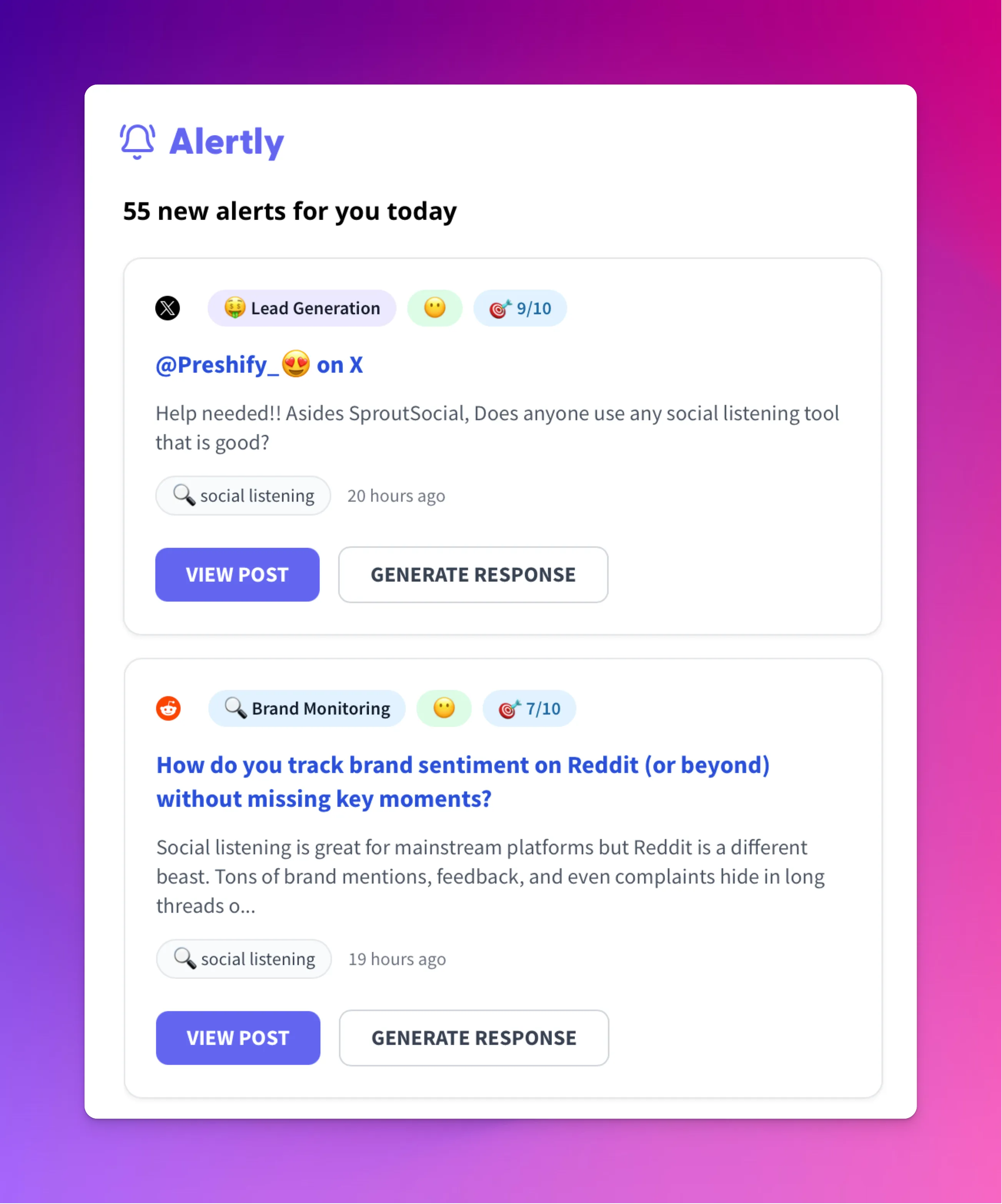
Every day, Alertly delivers fresh conversations where people are already asking for what you sell.
⚡ Get leads now
2. Social Listening in Plain English
Social listening means tracking specific keywords, phrases, or brand names across social media to spot relevant conversations.
It's not just "vanity tracking" to see if people mention you — that's brand monitoring.
The key difference:
Brand Monitoring
People are already talking about you.
Social Listening for Lead Gen
People are talking about their problems, needs, or your competitors — before they've even heard of you.
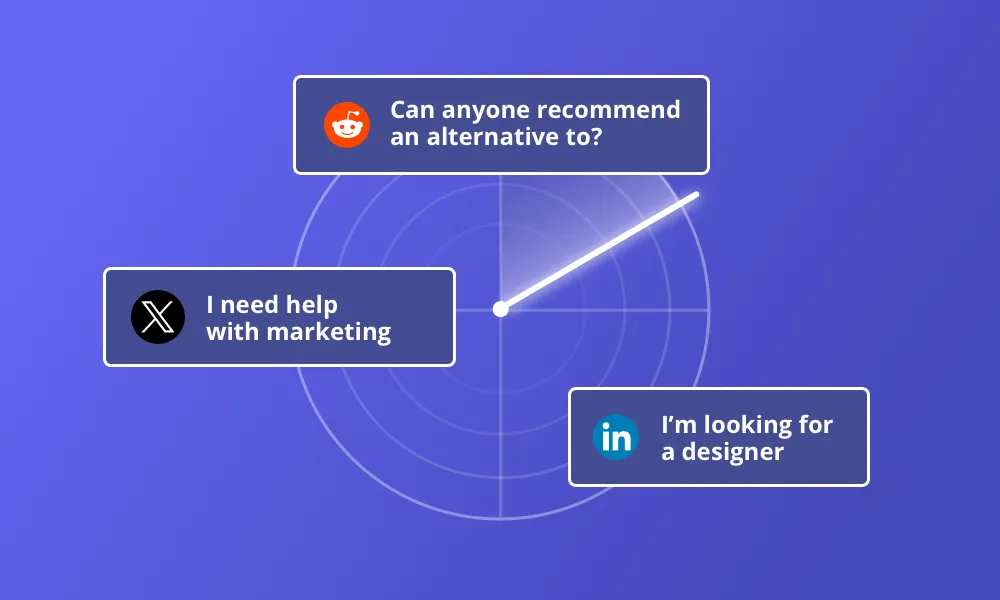
Think of it as sales radar: instead of cold-calling random prospects, you're tuning into real-time buying signals from people you know have a need.