
Social Listening vs Social Monitoring (Explained Simply)
They sound similar, but they answer different questions. This guide breaks down social listening vs social monitoring with examples, a comparison framework, and how to set each one up.
In this section, we'll cover:
If you’re deciding between social listening and social monitoring (or trying to do both), this will help you pick the right goal, keywords, workflow, and metrics — without wasting time on noise.
Definitions in plain English
What each one is — and what it isn’t
The key differences
Goals, signals, keywords, and outputs compared
Real examples
What you’ll actually see in the wild (monitoring vs listening)
When to use each one
Brand, support, product, PR, and lead generation
How to choose (simple framework)
A decision checklist you can apply in minutes
How to set both up
Keywords, platforms, filters, alerts, and routines
Metrics & reporting
What to track so it’s not just ‘mentions’
Common mistakes
Why most programs fail and how to avoid it
FAQs
Short answers + SEO FAQ schema
1. Definitions: Social Listening vs Social Monitoring
A quick way to remember it:
- Monitoring asks: “Are people talking about us?”
- Listening asks: “What are people saying about the problem we solve — and the alternatives?”
2. The Key Differences (Comparison Table)
Important: social listening and social monitoring are not mutually exclusive. Most teams need both — but they should be set up with different keywords, filters, and metrics.
3. Real Examples (Monitoring vs Listening)
Example A — Social monitoring (brand mention)
@YourBrand is down again. Anyone else seeing errors?
This is a monitoring alert: someone mentioned you. The goal is speed, triage, and resolution (support/ops).
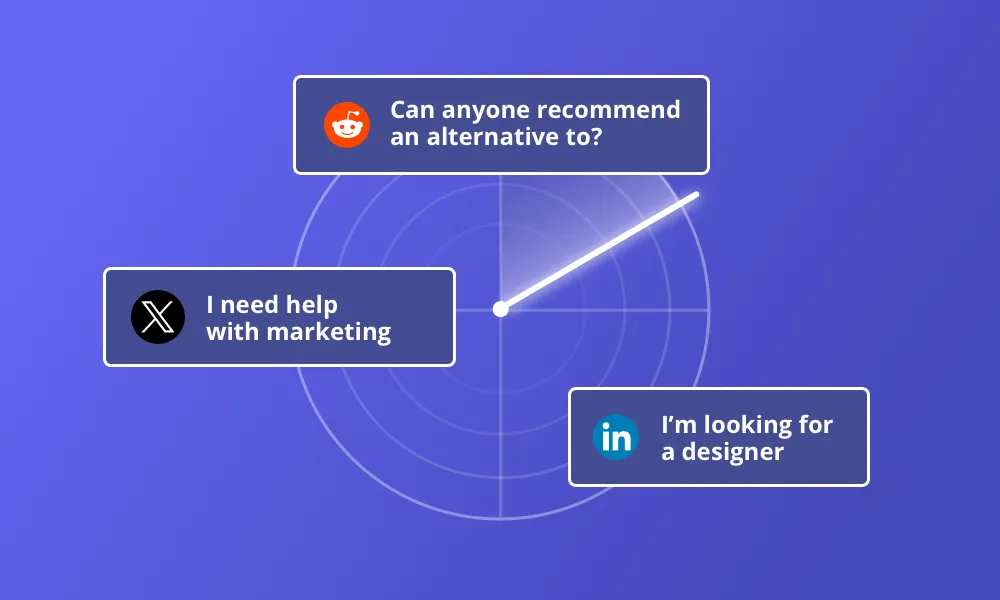
Example B — Social listening (problem + intent)
Looking for an alternative to [Competitor]. Their reporting is too limited — any recs?
This is a listening alert: there’s intent, but your brand isn’t mentioned. The goal is to join the conversation helpfully (and earn the right to pitch).
Example C — Social listening (language you can steal)
I need something that sends a daily digest of posts from Reddit + X so I don't miss leads.
This is gold for messaging. The person just wrote your value prop in customer language — use it in your homepage, ads, and onboarding.
4. When to Use Social Monitoring vs Social Listening
5. How to Choose (A Simple 3-Question Framework)
- Do we need to respond to direct mentions quickly? (If yes, monitoring.)
- Do we want to discover conversations where people ask for solutions? (If yes, listening.)
- Do we want customer language + insights for positioning/content? (If yes, listening.)
Here’s a practical rule:
6. How to Set Up Social Monitoring and Social Listening
A. Social monitoring setup (brand-first)
B. Social listening setup (problem + intent-first)
7. Metrics & Reporting (What to Track)
The biggest mistake is reporting “mentions” as the end goal. Mentions are just raw material — the value comes from action (support, PR, pipeline, and product learnings).
8. Common Mistakes (and Fixes)
Social Listening vs Social Monitoring: FAQs
Turn listening into pipeline
Alertly helps you monitor buyer intent keywords across Reddit, X, and LinkedIn — and sends a daily digest so you never miss high-intent conversations.
⚡ Start Your Free Alertly Trial