
What Is Brand Monitoring?
Brand monitoring is the process of tracking what people say about your brand, products, and key people in public — so you can respond faster, protect reputation, and turn customer feedback into better decisions.
In this section, we'll cover:
- 01 What brand monitoring is Monitoring vs listening vs reputation management
- 02 Why brand monitoring matters Brand protection, customer love, and growth signals
- 03 What to track The brand signals that actually change outcomes
- 04 Where to monitor What each platform is best for
- 05 Keyword playbook Exact keyword patterns: brand, products, execs, problems, comparisons
- 06 Alerts workflow How to route mentions to the right owner, fast
- 07 Action playbooks Support, marketing, and product responses you can run today
- 08 Common pitfalls Noise traps and measurement mistakes to avoid
- 09 Next steps A 20-minute weekly system for staying on top of your brand
1. What Is Brand Monitoring?
Brand monitoring is the practice of tracking public mentions of your brand and products across social platforms, forums, and communities — then using that signal to respond quickly and improve what you ship.
Monitoring (what happened)
Track mentions, posts, threads, videos, and engagement.
Example: “Someone posted a complaint about billing.”
Listening (why it happened)
Understand intent and patterns: objections, sentiment, and repeated pain.
Example: “Billing confusion happens after a pricing change.”
2. Why Brand Monitoring Matters
Your brand exists in public conversations. If you’re not monitoring them, you’ll find out late — usually when a thread is already ranking on Google, spreading on X (Twitter), or escalated to an influencer.
- 🧯 Catch issues early: Spot bugs, outages, billing problems, and support complaints before they snowball.
- 💬 Improve customer experience: See confusion points and fix onboarding/docs in the language customers use.
- 📣 Protect reputation: Respond to misinformation and correct narratives with receipts and clarity.
- 🎯 Find warm opportunities: “Is [your brand] any good?” and “Should I switch?” are high-intent mentions.
- 🧠 Product intelligence: Repeated “I wish it had…” posts are roadmap signals you can validate fast.
If you only monitor one thing: track your brand name + “pricing”, your brand name + “alternative”, and your product name + “bug”. Those three categories catch most high-risk and high-intent conversations.
3. What to Track: The Signals That Matter
Brand mentions alone are often context-free. The highest ROI comes from monitoring mentions tied to intent: problems, comparisons, buying decisions, and reputation risk.
🧨 Reputation risk & crises
Negative threads, allegations, security concerns, trust issues.
Look for: “scam”, “data”, “breach”, “unethical”, “lawsuit”.
🛠️ Bugs & reliability
Reports of broken flows, outages, and regressions.
Look for: “down”, “error”, “won’t load”, “stuck”, “can’t login”.
💸 Pricing & billing friction
Refunds, plan confusion, surprise charges, price increases.
Look for: “charged”, “refund”, “cancel”, “too expensive”.
⚖️ Comparisons & alternatives
People deciding between you and competitors.
Look for: “[your brand] vs”, “alternative to [your brand]”, “switching from”.
🌟 Praise & advocacy
Users recommending you or sharing wins.
Look for: “highly recommend”, “love”, “best”, “saved me”.
🧩 Feature requests & confusion
Requests, missing features, and onboarding friction.
Look for: “how do I”, “does it support”, “wish it had”, “missing”.
4. Where to Monitor: What Each Platform Is Best For
Different platforms produce different signals. You don’t need to monitor everywhere — you need the channels where your customers talk and where narratives spread.
X (Twitter): real-time spikes
Great for fast-moving issues, launches, and sentiment shifts.
Related: Twitter Monitoring
Reddit: deep reviews + alternatives
Great for long-form complaints, comparisons, and “is it worth it?” threads.
Related: Reddit Monitoring
LinkedIn: B2B credibility + trust
Great for B2B reputation, procurement objections, and founder/exec narratives.
Related: LinkedIn Monitoring
YouTube: reviews + tutorials
Great for creator reviews, “how-to” content, and perception at scale.
Related: YouTube Monitoring
If you’re starting from zero, begin with Reddit + X (Twitter). They surface the highest volume of brand opinions and “alternatives” intent for most categories.
5. Brand Monitoring Keyword Playbook
Keywords are the engine. Brand monitoring fails when you only track your brand name — it catches noise and misses context. Use keyword clusters that capture intent, risk, and buying decisions.
Core brand monitoring keywords (copy/paste)
[brand name]and common misspellings[product name]and feature names[brand] pricing,[brand] refund,[brand] cancel[brand] down,[brand] error,[brand] bug,can't login [brand][brand] alternative,alternative to [brand],[brand] vs[brand] scam,[brand] legit,[brand] security,[brand] privacy
Use “problem-first” keywords to find brand mentions you didn’t expect
Customers often describe the problem before they name the brand. Add problem phrases that map to what you solve.
“Any tool that monitors brand mentions on Reddit?”
“Need an alternative to Google Alerts for brand monitoring.”
“Best way to track brand mentions across X and YouTube?”
6. Turn Keywords Into a Daily Alerts Workflow
The hardest part isn’t finding mentions — it’s turning them into consistent action. A simple workflow keeps signal high and response time low.
🛠️ Manual monitoring (brittle)
Native searches and tab juggling. You’ll catch some mentions — and miss most.
- Search your brand name periodically
- Rely on teammates forwarding screenshots
- Respond late (or not at all)
🤖 Automated monitoring (scales)
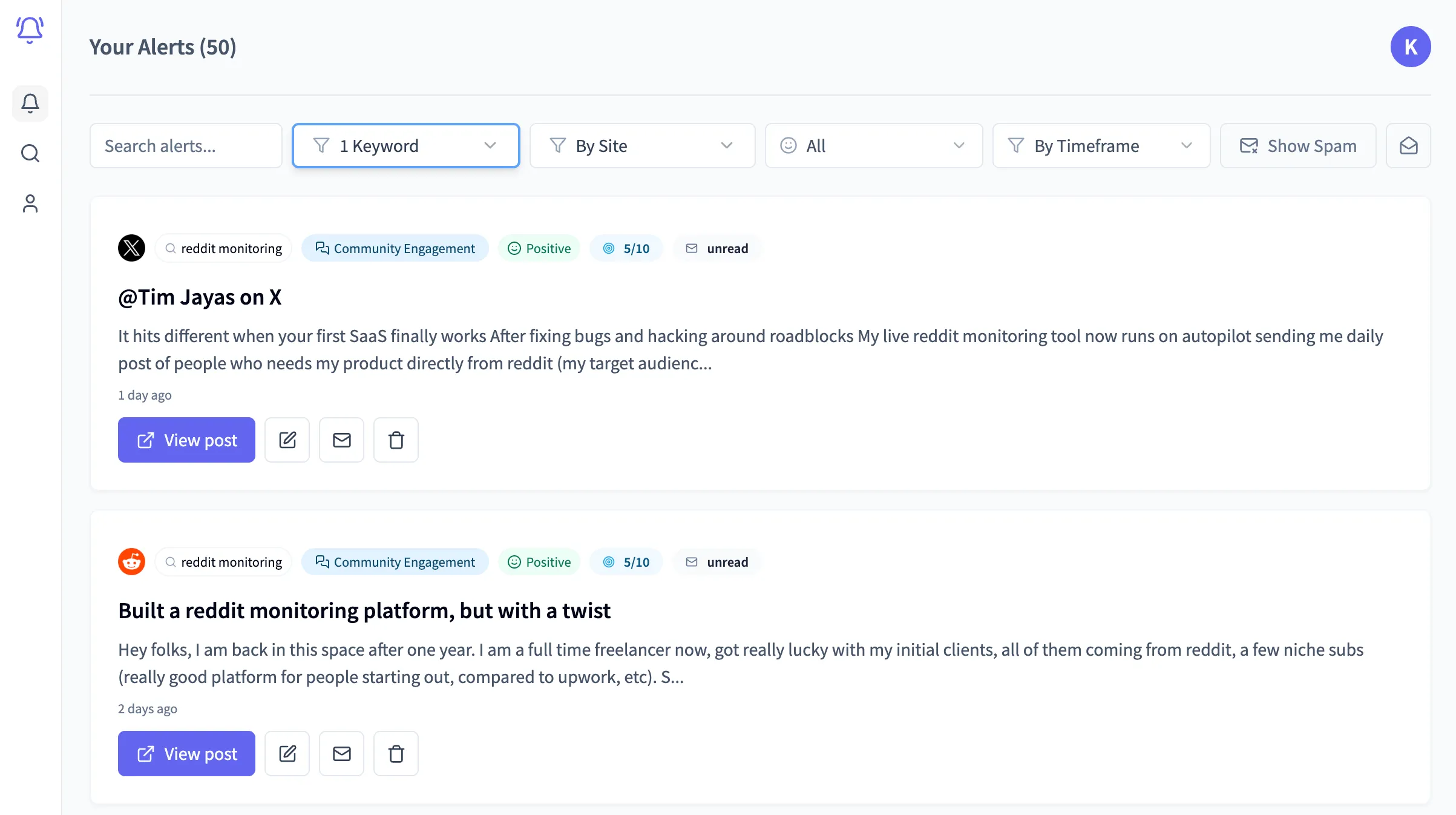
Use Alertly to track your keywords across sources and get a daily digest you can act on.
- Add brand + intent keywords once
- Receive a daily digest of matches
- Route high-risk items to the right owner
Triage in 3 buckets
- 🔥 Respond now: security claims, viral negativity, billing issues, urgent bugs.
- 🧠 Learn: repeated confusion, objections, feature requests, competitor comparisons.
- 📣 Amplify: praise, recommendations, positive reviews, creator mentions.
7. Action Playbooks: What To Do With Brand Mentions
Monitoring only creates leverage when it changes what you do next. These playbooks make the signal actionable.
Support playbook: fix issues in public
Trigger: “I can’t login / it’s broken / support isn’t replying.”
Action: respond with empathy, ask for details, and follow through visibly.
Asset to build: a fast “known issues” page and a clear status link.
Marketing playbook: turn praise into proof
Trigger: “This tool saved me hours” / “best tool for…”
Action: ask permission to quote; turn into testimonials, case studies, and landing page proof.
Asset to build: a “what customers say” page with real screenshots.
Product playbook: prioritize real pain
Trigger: repeated “I wish it had…” / “confusing onboarding” mentions.
Action: tag theme → validate with 5 users → ship the fix.
Asset to build: a changelog post that closes the loop (“you asked, we shipped”).
Reputation playbook: correct narratives
Trigger: misinformation, rumor threads, “is it legit?” questions.
Action: respond with facts, links, and calm clarity. Avoid defensiveness.
Asset to build: a short trust page: security, privacy, refunds, and policies.
Reply templates (keep them human)
Bad reply
Please email support. We can’t help here.
Good reply
Sorry you hit this — that’s frustrating. Can you share your plan + what error you see? If you DM your email, I’ll get this escalated and follow up here once it’s fixed.
8. Common Pitfalls (and How to Avoid Them)
🌪️ Monitoring only your brand nameThat catches a lot of noise and misses context. Add intent phrases (pricing, bug, alternative, vs, cancel, refund).
🧍 No ownershipIf no one owns response and triage, alerts pile up. Route “Respond now” mentions to a single owner or inbox.
🧨 Fighting in publicDefensive replies escalate threads. Acknowledge, clarify with facts, and move to resolution — then close the loop publicly.
📉 Measuring only volumeThe goal isn’t “more mentions” — it’s faster resolution, fewer repeated complaints, and more advocacy. Track response time and themes.
9. Next Steps: Your 20-Minute Weekly Brand Monitoring System
- List your brand name, product names, and common misspellings
- Create intent keyword sets: pricing/billing, bugs/outages, alternatives/vs, security/trust
- Start with Reddit + X (Twitter), then add LinkedIn/YouTube based on your audience
- Set a daily digest review (10 minutes) + a weekly theme review (10 minutes)
- Turn the top repeated theme into one fix or one asset (docs update, FAQ, comparison, trust page)
Know what people say about your brand — before it's too late
Alertly helps you monitor brand conversations across social media so you can respond faster, protect your reputation, and learn what customers actually need.